
Building Responsive Education Policies for Emerging Social Needs
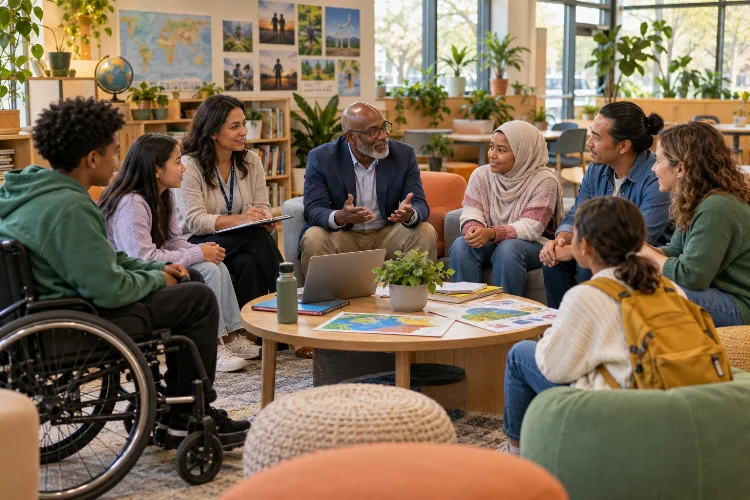
Education policy has always responded to society, but the speed of social change is making that job much harder.
Schools are dealing with student mental health concerns, digital inequality, artificial intelligence, migration, demographic shifts, climate disruption, changing family structures, and new expectations about skills and work.
These issues rarely arrive one at a time. They overlap, and their effects can look very different from one community to another.
That is why building responsive education policies for emerging social needs has become a strategic priority for governments, school systems, universities, and other education organizations.
UNESCO’s current work on education beyond 2030 points to technological transformation, climate pressure, inequality, conflict, demographic change, disinformation, and shifting labor markets as major forces already reshaping how people learn and participate in society.
The challenge is not to write a new policy every time society changes. It is to create education systems that can recognize new needs early, respond intelligently, and adapt without losing long-term educational purpose.
1. Start by Recognizing That Social Needs Are Changing Faster
Traditional education policy often assumes that the environment surrounding schools changes relatively slowly.
A policy is developed, implemented over several years, reviewed, and eventually replaced.
That cycle is becoming harder to maintain.
Artificial intelligence can change learning behavior within months. Migration can rapidly alter the linguistic and cultural profile of a school district. Extreme weather can interrupt education with little warning. Economic disruption can create sudden demand for reskilling.
Demographic change adds another layer.
Some countries face rapidly growing youth populations and pressure to expand access. Others are dealing with aging populations, smaller student cohorts, and a need to support learning across longer working lives.
OECD’s Education Policy Outlook 2025, which draws on 230 policies across 35 education systems, argues that technological and demographic shifts are changing when, where, and why people learn. It stresses that people increasingly need to learn, unlearn, and relearn throughout life.
Move From Reactive Policy to Early Detection
A responsive system needs mechanisms for spotting change before it becomes a crisis.
That could involve monitoring demographic data, student surveys, attendance, mental-health indicators, labor-market trends, digital-access data, migration patterns, and climate risks.
Frontline feedback matters as well.
Teachers may notice changes in student behavior before national statistics show anything. School counselors may identify new well-being concerns. Community organizations may see groups struggling to access education long before those problems reach government reports.
Policy intelligence should therefore combine data with human observation.
The goal is not to predict every social change.
It is to notice emerging patterns early enough to respond thoughtfully.
2. Put Equity at the Center of Responsive Policy
Social change rarely affects everyone equally.
New technology may create opportunities for students with reliable internet access while increasing disadvantage for students without devices.
Climate disruption can affect all schools, but communities with weaker infrastructure may experience longer closures.
Migration can enrich learning environments while creating additional language and support needs for recently arrived students.
Responsive education policy should therefore ask not only what is changing but who is most affected.
OECD’s work on equity and inclusion identifies demographic shifts, migration and refugee movements, inequality, and climate change as forces increasing diversity across education systems.
It recommends addressing inclusion through governance, resources, capacity building, school-level action, and monitoring.
Design for the Learner at the Edge
Policies are often designed around an average student.
That average student may not actually exist.
A better test is to ask how a proposed policy works for learners facing the greatest barriers.
Would a digital-learning policy work for a student with limited connectivity?
Can a newly arrived migrant understand the enrollment process?
Can a learner with a disability access the same platform?
Does an adult learner with full-time work have realistic opportunities to participate?
Designing for these situations often improves the system for everyone.
For example, simplified enrollment procedures may help migrant families but also make registration easier for all parents. Flexible learning options may support students experiencing disruption while also serving working adults.
Inclusion works best when it is built into policy design rather than added later as an exception.
3. Treat Mental Health and Well-Being as Education Issues
Schools cannot solve every social problem.
But they also cannot pretend that student well-being exists outside education.
Stress, anxiety, violence, exclusion, family instability, and other pressures can directly influence attendance, engagement, relationships, and learning.
UNESCO, UNICEF, and WHO reported in 2026 that around one in seven adolescents globally experiences a mental health condition.
Their guidance emphasizes schools as important environments for creating safety, positive relationships, social-emotional skills, early recognition of distress, and connections to appropriate support.
This does not mean turning teachers into therapists.
It means designing education policies that acknowledge the relationship between well-being and learning.
Build Support Around the School
Responsive systems need links between education, health, social services, families, and community organizations.
A student dealing with serious mental-health challenges may need specialist services that a teacher cannot provide.
The school’s role could be recognizing concerns, creating a supportive classroom enviroment, following clear safeguarding procedures, and connecting learners with appropriate services.
UNESCO’s 2025 handbook on integrating health and well-being into education planning similarly argues that mental health, physical health, nutrition, safety, and supportive learning environments should be considered within education-sector planning rather than treated as disconnected policy areas.
That requires cross-sector coordination.
Education ministries cannot realistically solve health and social-care problems alone.
But policies can ensure that schools are not left isolated when student needs cross institutional boundaries.
4. Respond to Digital Change Without Assuming Technology Is the Answer
Digital transformation creates one of the biggest policy challenges in modern education.
Technology can expand access, personalize learning, provide new teaching resources, and connect learners across distance.
It can also deepen inequality, create privacy risks, increase exposure to harmful content, and introduce tools faster than schools can evaluate them.
Responsive policy therefore requires more than buying devices.
OECD’s 2025 survey on digital school education examined policies across 37 jurisdictions, covering areas including governance, curriculum, assessment, infrastructure, procurement, educator capacity, human resources, and monitoring.
This illustrates how broad digital transformation really is.
Design Digital Policy Around Educational Purpose
The first question should not be, “Which technology should we buy?”
It should be, “Which learning or access problem are we trying to solve?”
If students in remote areas need more course options, digital delivery may help.
If teachers need faster formative feedback, technology may support assessment.
If AI tools are increasingly used by students, policy may need to address responsible use, academic integrity, data privacy, and AI literacy.
Technology becomes useful when it solves an identified educational problem.
OECD also notes that policy attention increasingly includes children’s digital safety, credibility assessment, digital literacy, and well-being—not simply access to devices.
That is an important shift.
The digital divide is no longer only about having internet access.
It also involves whether learners have the skills, support, safety, and judgment needed to benefit from digital environments.
5. Prepare Education Systems for Climate Disruption
Climate change is an education issue in at least two ways.
First, students need knowledge and capabilities that help societies respond to environmental change.
Second, education systems themselves need to survive climate shocks.
Floods, extreme heat, storms, fires, and other events can damage schools, disrupt transportation, force closures, and create displacement.
UNESCO’s 2026 education foresight work specifically identifies climate and environmental pressures as forces shaping the future of education.
Responsive policies should therefore include both climate learning and operational resilience.
Plan for Continuity Before an Emergency
Schools should not develop continuity plans while a disaster is already happening.
Education systems can identify high-risk areas, assess infrastructure, develop alternative learning arrangements, strengthen communication systems, and prepare condensed or flexible curricula for periods of disruption.
Schools can also become important community resilience hubs.
UNESCO’s work in the Pacific during 2026 highlighted efforts to combine climate-smart education with life skills, bringing policymakers, teacher educators, and curriculum specialists together to strengthen system resilience and learner capability.
This shows why climate policy should not be isolated inside environmental programs.
Facilities, curriculum, teacher development, emergency planning, and community partnerships may all need to change together.
6. Make Policies Responsive to Migration and Growing Diversity
Many education systems are becoming more diverse.
Students may speak different home languages, arrive with different educational histories, follow different migration pathways, or experience displacement.
A policy designed for a relatively homogeneous population may no longer fit.
This does not mean creating a separate education system for every group.
It means designing enough flexibility to serve learners with different starting points.
OECD’s inclusion research highlights migration, refugee crises, demographic change, and increasing social diversity as important challenges for education policy.
Build Flexibility Into Access and Support
A recently arrived student may need language support.
Another may have interrupted schooling and require foundational catch-up learning.
Families unfamiliar with the local education system may need clearer guidance.
Schools may also need intercultural competence and strategies for preventing discrimination.
The strongest policies avoid assuming that enrollment alone equals inclusion.
A student can technically have a place in school while remaining academically or socially excluded.
Responsive policy therefore looks beyond access to participation, belonging, achievement, and progression.
This is where disaggregated data becomes valuable.
National averages can hide persistent gaps affecting particular communities.
Leaders need enough information to see who is succeeding and who is disappearing inside the average.
7. Update Education Around New Social and Labor-Market Expectations
Education systems are also under pressure because the relationship between learning and work is changing.
People may have longer careers, change occupations several times, and need repeated periods of reskilling.
That creates social needs extending beyond school-age learners.
OECD’s 2025 policy outlook argues for a stronger lifelong-learning perspective as technological transformation and longer lives change traditional patterns of education, employment, and retirement.
Responsive policy should therefore make room for adults returning to education.
Think Beyond the Traditional Degree
Flexible programs, recognition of prior learning, modular qualifications, microcredentials, career guidance, and online or blended delivery can help people re-enter education throughout life.
The important part is creating pathways that people can understand.
Someone who loses a job because of automation may not need another four-year degree.
They may need targeted training, a short credential, career guidance, and a pathway into further learning if necessary.
Policy should make those transitions easier.
This requires collabration between education institutions, employers, workforce agencies, and social-protection systems.
Education policy increasingly intersects with labor and economic policy.
Treating those areas as completely separate can leave learners navigating fragmented systems at the exact moment they need support most.
8. Build Social and Emotional Skills Into the Policy Agenda
Emerging social needs are not only technical or economic.
Students are growing up in environments shaped by polarization, misinformation, conflict, social media, and rapidly changing social expectations.
Education therefore needs to support capabilities such as self-management, empathy, cooperation, responsible decision-making, and constructive disagreement.
UNESCO’s policy guidance on social and emotional learning argues that SEL can contribute to academic achievement, reduced dropout, mental health and well-being, and healthier relationships across classrooms and communities.
Avoid Turning SEL Into Another Standalone Program
A common mistake is adding social-emotional learning as another item on an already overloaded curriculum.
A more sustainable approach is integration.
Classroom discussion can develop respectful disagreement.
Group projects can strengthen collaboration.
Reflection can support self-awareness.
School leadership can reinforce belonging and positive relationships.
Assessment systems should also avoid undermining these goals through environments dominated entirely by competition and high-stakes pressure.
Responsive policy works best when different parts of the system reinforce the same priorities.
9. Build Cross-Sector Partnerships Around Complex Needs
Schools cannot independently solve poverty, mental-health shortages, digital exclusion, unemployment, family instability, or community violence.
Trying to do so can overload educators.
Instead, policies can create structured partnerships.
OECD research on school partnerships notes that education institutions increasingly work with external actors to address physical health, emotional well-being, social needs, and children’s use of digital technology.
The important word is structured.
Partnerships need responsibilities, referral systems, information-sharing rules, funding, and accountability.
Coordinate Services Around the Learner
Imagine a student experiencing chronic absenteeism.
The cause might be academic difficulty.
It could also involve mental health, transportation, housing instability, caring responsibilities, or bullying.
A purely educational response may miss the actual problem.
Responsive policy makes it easier for relevant services to coordinate without forcing families to navigate a maze of disconnected institutions.
That does not mean sharing sensitive information carelessly.
Privacy and safeguarding still matter.
The goal is to make institutional boundaries less visible to the learner who needs support.
10. Use Foresight Without Trying to Predict the Future Perfectly
Responsive education policy needs to look forward.
But forecasting is difficult.
Nobody knows exactly how AI, climate change, migration, employment, or political conditions will develop over the next decade.
This makes strategic foresight more useful than one fixed forecast.
UNESCO’s current education-beyond-2030 process explicitly uses foresight to examine uncertainty around technology, climate, inequality, democracy, conflict, demographic change, and labor markets.
Plan for Several Plausible Futures
Education leaders can develop scenarios.
What happens if AI adoption accelerates faster than expected?
What if climate disruptions create more frequent school closures?
What if migration increases?
What if a region experiences rapid population decline?
The objective is not to predict which scenario will happen exactly.
It is to test whether current policies remain workable under different conditions.
A resposive system has options.
It can scale digital learning when physical attendance is disrupted.
It can adjust teacher deployment as demographics shift.
It can expand language support when migration patterns change.
Foresight turns uncertainty into a planning input rather than an excuse for inaction.
11. Give Local Institutions Room to Adapt
National policy provides consistency.
Local institutions understand context.
Responsive systems need both.
A rural school dealing with teacher shortages may require different implementation strategies than a large urban school.
A university serving working adults may need different schedules and support services from a residential institution serving mostly recent school graduates.
Policies should clearly identify non-negotiable outcomes while allowing flexibility in how institutions achieve them.
Combine Autonomy With Evidence
Local flexibility should not mean every institution does whatever it wants.
Schools and universities need clear goals, appropriate resources, transparent accountability, and data showing whether local adaptations are working.
The same intervention may be implemented differently across communities while still pursuing the same educational objective.
This helps systems respond to diversity without losing coherence.
It also creates opportunities to learn.
If one region develops an effective solution to a new social challenge, policymakers can study the model and consider whether it should be adapted elsewhere.
Local innovation becomes part of national policy intelligence.
12. Review Policies Continuously Instead of Waiting for Failure
The final ingredient is adaptation.
Responsive education policy cannot be treated as permanent once approved.
Social conditions change too quickly.
UNESCO IIEP’s 2026 planning strategy emphasizes collective and agile implementation as education systems respond to technology, demographic shifts, constrained budgets, crises, and other evolving challenges.
That requires a different policy culture.
Build Learning Into the Policy Cycle
Leaders should periodically ask whether the original problem still exists in the same form.
Is the target population changing?
Have unintended consequences appeared?
Are local institutions implementing the policy as expected?
What are students and families reporting?
Have new technologies changed what is possible?
Policies can then be adjusted without waiting for a major failure or a completely new reform cycle.
This creates continous policy learning.
Some policies may need expansion.
Others may need simplification.
A few may no longer be useful at all.
Ending an outdated policy should not automatically be viewed as failure.
Sometimes it is evidence that the system is paying attention.
Building responsive education policies for emerging social needs means accepting that education does not operate separately from society.
Digital transformation, mental health, migration, climate change, inequality, demographic shifts, and changing patterns of work are already influencing who learns, what they need, and what prevents them from succeeding.
Effective policy should anticipate change without chasing every trend. It should combine evidence, equity, stakeholder knowledge, cross-sector partnerships, local flexibility, and regular review.
Most importantly, responsiveness should become a system capability rather than an emergency reaction.
Start by examining one major education policy and asking whether the social conditions it was designed for still exist today. Then identify what has changed, which learners are affected most, and what evidence would justify adaptation.
That is how education policy stays relevant in a world that refuses to stand still.